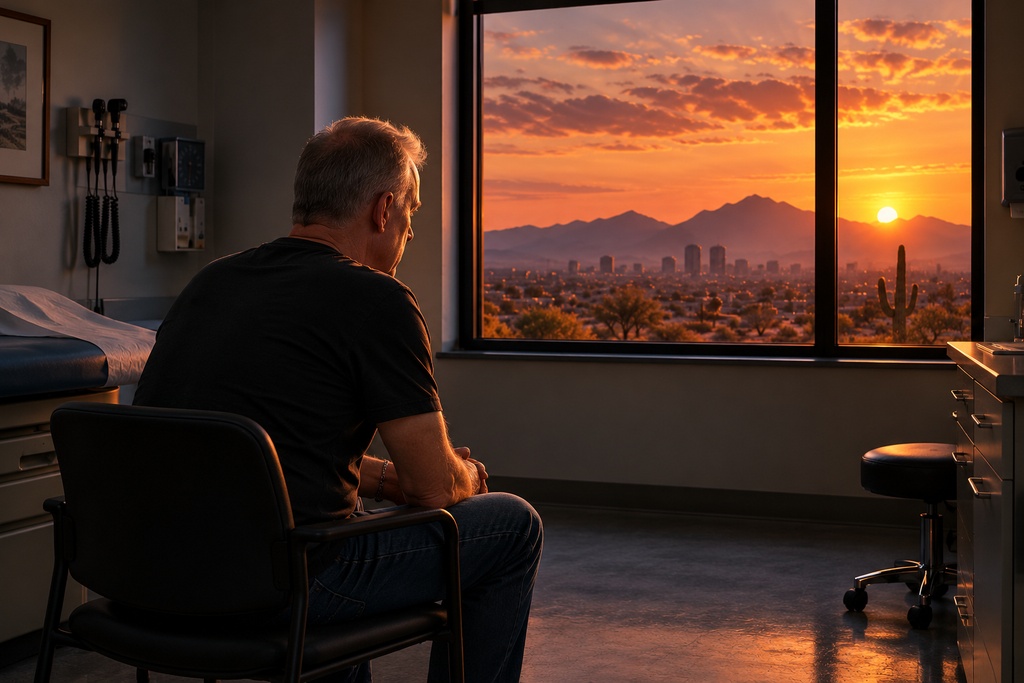
The doctor said the word, and for a second I didn’t hear anything after it.
Cancer.
I knew what he’d said. I understood the word. But the rest of the conversation seemed to move farther away from me, as if someone had lowered the volume on the room. The doctor kept talking. I could see his mouth moving. I could hear pieces of sentences. None of it was landing.
I was sixty-two years old, and almost immediately I thought about my father.
He died at seventy-four. Not from cancer, but from an infection after being mistreated in a hospital. The circumstances were different, and I knew that, but sitting in that office I wasn’t interested in technical distinctions. My mind had already done the math.
Twelve years.
That was the number that stayed with me.
I was twelve years younger than my father had been when he died. Before that afternoon, twelve years sounded like a long time. It sounded like enough time to put things off, enough time to make changes later, enough time to believe there would always be another season, another trip, another chance. Suddenly, twelve years didn’t feel generous at all.
That’s one of the first things cancer did to me. Before radiation, before treatment schedules, before the physical exhaustion, it changed my relationship with time.
Most of us live as if the future is already promised. We know intellectually that it isn’t, but we don’t organize our lives around that fact. We delay the difficult decisions. We keep jobs we don’t love. We stay in routines because they’re familiar. We tell ourselves that one day we’ll travel, one day we’ll slow down, one day we’ll finally build the life we keep imagining.
Then somebody says cancer, and “one day” starts sounding dangerously vague.
I’d love to tell you I walked out of that office transformed, fearless and completely certain about what came next. I didn’t. I was scared. I didn’t know what treatment would look like, how sick I might become, whether it would work, or what kind of life would be waiting on the other side of it.
And yes, I wondered if I was going to die.
That question sits in the room whether anyone says it out loud or not.
But fear wasn’t the only thing I felt. Somewhere underneath it was a quieter thought, one I couldn’t fully explain yet. If I got through this, I didn’t want to return to the same life and pretend nothing had happened. I didn’t want cancer to become something I survived only to go back to sleep.
I didn’t know then that I’d spend nine weeks in radiation treatment. I didn’t know how exhausting those weeks would become, or how much time they would give me to think. I didn’t know that within months I’d retire early, sell almost everything I owned, and reduce sixty-two years of life to twelve suitcases.
I certainly didn’t know I’d leave Phoenix.
At that point, Phoenix was still home. My working life had taken me through restaurants, hotels, my courier business, and finally the Postal Service. I’d spent decades doing what adults are supposed to do: work, pay bills, solve problems, keep moving. There was nothing unusual about that life. That was part of the problem.
Cancer forced me to look at it differently.
It made me ask whether I was actually living the life I wanted, or whether I had simply become good at maintaining the life I already had.
Those are not the same thing.
The answer didn’t arrive all at once. Neither did Costa Rica. There were months between the diagnosis and the day I boarded a plane with those suitcases. There were treatments, conversations, decisions, doubts, and a hundred smaller moments that slowly moved me toward a life I couldn’t yet see.
There would eventually be loneliness, culture shock, mistakes, books, business ideas, love, jealousy, and days when Costa Rica felt exactly like paradise. There would also be days when it didn’t. I’d meet people I never could have predicted meeting. I’d fall in love when I wasn’t looking for it. I’d begin writing a different chapter of my life at an age when many people are told they should be settling into the one they already have.
But none of that had happened yet.
That day, I was simply a sixty-two-year-old man sitting in a doctor’s office in Phoenix, trying to understand how one word could make the future feel completely different.
Cancer.
The fluorescent lights were still on. The world outside the room was still moving. Nothing around me looked different.
But I was.
And somewhere beneath the fear, a decision had started forming.
If I got through this, I wasn’t going to waste what came next.
That much felt absolutely clear.