It was almost New Year’s Eve, and millions of people were getting ready to watch that giant ball in Times Square light up the night. I was waiting for something else to light up.
A few days earlier, I’d had my PET scan. I’d never been inside one of those machines before, and I’m a little claustrophobic to begin with, so I was nervous before I walked through the door. The imaging center looked like the kind of place that seems to be popping up on every corner now, somewhere between a medical office and a pharmacy. Everything inside was cold, bright, sterile, and surgically clean. It smelled like a hospital, which did nothing to make me feel better.
I was the first appointment that morning, so I didn’t have much time to sit in the waiting room and think myself into a panic. They got me back quickly, explained what was going to happen, and before long I was lying there wondering why a machine designed to look at the inside of your body had to make you feel so trapped on the outside. The whole thing took about forty-five minutes, and then I went home.
That was the part I still didn’t understand. The machine had just scanned me, so somewhere there was already an image of what was happening inside my body. But I couldn’t see it, and nobody could tell me anything. The scan had to be sent to somebody else to read, interpreted, and then sent to the oncologist so he could interpret it too.
Ten days, they told me. Ten days is a long time when you’re waiting to find out whether cancer stayed where it started or caught the subway somewhere else. Waiting had become its own strange part of the process. You do the test, go back to work, eat dinner, watch television, and somehow try to live like there isn’t a clock running in the back of your head. Mine never really stopped.
By the time I sat down with the oncologist, Christmas was behind me and New Year’s Eve was close enough that Times Square was starting to creep into the television coverage. I was alone at the appointment, which by then felt almost normal.
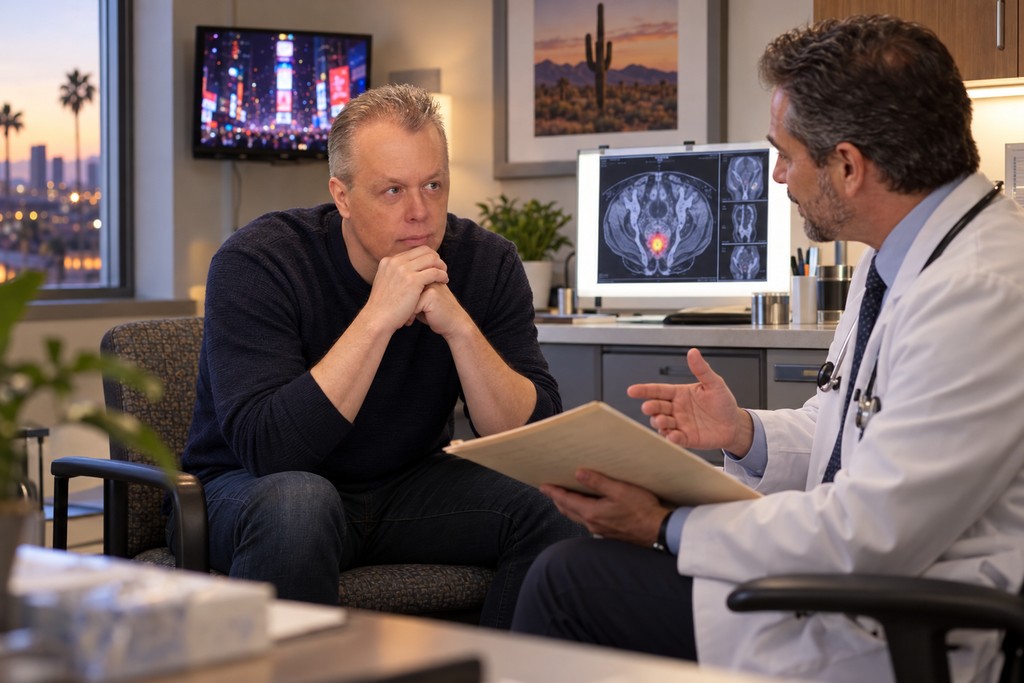
The oncologist walked in carrying my chart and felt different from some doctors I’d seen before. He didn’t rush. He didn’t stand at the door like he had one foot already pointed toward the next patient. He sat down, looked through the paperwork, and started talking to me like we had time.
Then he said the sentence I still remember: “Your prostate really lit up the scan.”
Well, hell. Normally, lighting something up at the end of December is supposed to be a good thing. Christmas trees. Houses. City skylines. That giant ball hanging over Times Square waiting for midnight. Apparently, a prostate was not on that list.
What he said next changed the appointment. The cancer was stage one. It hadn’t spread. They’d caught it early. He wanted to treat it aggressively to make sure it stayed that way, and he told me he believed there was a high chance we could take care of this the first time.
For months, every new piece of information had seemed to create another question. This was the first conversation that felt like it was giving me answers. He wasn’t just telling me what was wrong; he was telling me what we were going to do about it.
I was in that office with him for about forty-five minutes, and not once did he make me feel like I was holding up his day. He walked me through the treatment, what would happen before it started, what the weeks would look like, and what would happen afterward. He answered everything I asked and explained things I hadn’t even thought to ask yet.
Doctors have a way of making you feel like just a number when they’re moving fast enough. He never made me feel that way. He made me feel like there was a plan, and after months of uncertainty, that mattered more than I realized.
I was still nervous. Radiation wasn’t exactly something I was looking forward to. But his confidence was contagious, and he carried himself like a man who had seen this before and knew exactly what to do next. By the time I left, I believed him too.
I’d gone into that office worried about how brightly my prostate had lit up the scan. I walked out realizing the doctor had lit up something else entirely: what came next. Nine weeks. A treatment plan. A doctor who believed we could beat it.
Times Square had nothing on me.
Because before midnight ever arrived that New Year’s Eve, my future finally looked bright again.